

AI Restaurant Marketing (2026 Guide)
How AI Is Reshaping Restaurant Discovery, Visibility, and Growth
AI now influences how guests find restaurants, how reviews are summarized, how ads are optimized, and how marketing decisions are made—often before anyone clicks.

What AI Restaurant Marketing Means
AI helps restaurant brands make better decisions by identifying patterns and opportunities humans can’t spot at scale.
In practice, this means:
- Pattern recognition across search, reviews, and performance data
- Faster, data-informed decision-making
- Content and insights based on real guest behavior
- Optimization across channels (search, ads, websites, retention)
AI doesn’t replace strategy – it amplifies it when the fundamentals are in place.
What AI Restaurant Marketing Is Not
To avoid confusion, it’s important to be clear about what this is not:
❌ A replacement for strategy
❌ A plug-and-play growth solution
❌ A shortcut to rankings or revenue
❌ Something that works without clean data and structure
Without a strong foundation—website, search visibility, reviews, and conversion paths – AI simply accelerates the wrong outcomes.
Why This Distinction Matters
AI doesn’t fix broken marketing—it amplifies whatever system already exists.
When restaurants apply AI without a clear strategy, clean data, and connected channels, the result is usually more noise, not more growth. Automation accelerates mistakes just as easily as it accelerates wins.
That’s why AI works best when it’s layered into a connected restaurant marketing system—one where visibility, conversion, and retention are designed to work together, not operate in silos.
Where AI Is Impacting Restaurants Right Now
AI is already influencing how restaurants are discovered, evaluated, and chosen—often before a guest ever clicks a website. These shifts aren’t future trends; they’re happening now across the core digital touchpoints that drive demand.
AI Search & Discovery
Search has shifted from keywords and blue links to summaries, recommendations, and intent-based answers. Google, Maps, and AI-powered search engines now decide which restaurants are visible before a guest ever clicks.
AI evaluates brand authority, location consistency, reviews, menu relevance, and website structure—making restaurant SEO and AI search visibility inseparable.
Reviews & Reputation
AI does not read individual reviews – it analyzes sentiment patterns at scale. Recurring themes across platforms influence how your restaurant is summarized, ranked, and recommended.
That’s why restaurant reputation management now affects both trust and visibility – not just perception.
Advertising & Optimization
Paid platforms increasingly rely on AI to manage bidding, targeting, and creative performance. Without structure, AI optimizes toward the wrong outcomes across locations.
When applied correctly, restaurant PPC and paid advertising becomes more efficient, scalable, and measurable.
Website Experience
AI favors fast, structured, conversion-ready websites. Your site is now a signal source for search, ads, and AI summaries.
Without conversion-focused restaurant websites, AI-driven traffic won’t convert – even if visibility improves.
Why This Matters: AI works best when every channel is connected through a unified digital marketing system for restaurants.
The 2026 Framework:
Using AI in 3 Layers
AI delivers real results when it’s applied across the full restaurant marketing system. In 2026, that system works in three connected layers—each building on the one before it.
Layer 1:
Foundation
(What AI Reads First)
AI evaluates the same fundamentals guests experience—just at scale.
If your foundation is weak, AI amplifies the problem.
This layer includes:
- Website performance and structure
- Local listings and data consistency
- Reviews, ratings, and sentiment signals
Strong foundations make restaurant SEO and AI search visibility work together instead of competing.
Layer 2:
Activation
(How AI Optimizes Performance)
Once the foundation is solid, AI can optimize execution across channels.
This layer includes:
- Paid media optimization and budget allocation
- Content performance and testing
- Cross-channel attribution and insights
Applied correctly, restaurant PPC and paid advertising becomes more efficient and scalable—without guesswork.
Layer 3:
Scale
(How AI Supports Growth)
At scale, AI helps brands maintain consistency while executing locally.
This layer includes:
- Multi-location governance
- Location-level personalization
- Centralized reporting and decision-making
This is where multi-location restaurant marketing systems create repeatable growth instead of operational chaos.
Framework Summary: AI doesn’t replace marketing – it strengthens it when applied in the right order. Foundation enables activation. Activation enables scale. That’s the difference between tools and a system.
Your AI-Ready Restaurant Marketing Stack
AI doesn’t replace the fundamentals of restaurant marketing. It amplifies them. An AI-ready setup starts with a strong foundation—then adds intelligence on top to guide decisions, optimize performance, and scale what works.
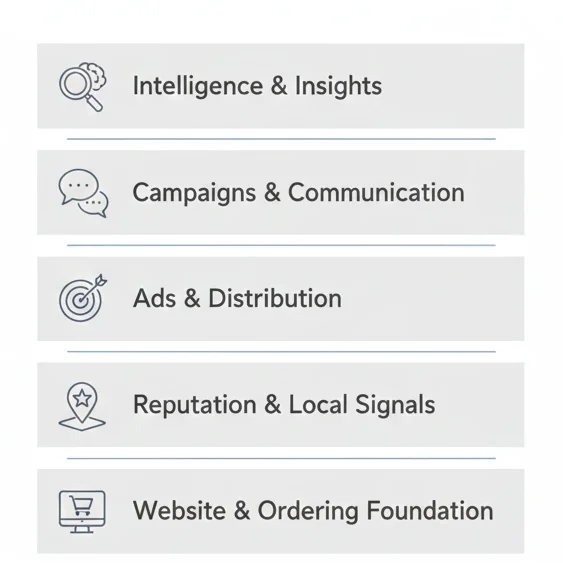
Intelligence & Insights
AI analyzes performance, identifies patterns, and highlights what to fix or prioritize next—turning data into direction.
Campaigns & Communication
Email, SMS, and paid campaigns use AI to optimize timing, messaging, and audience targeting—based on real engagement signals.
Ads & Distribution
Search and social advertising leverage AI for bidding, creative testing, and budget allocation—guided by conversion data, not guesswork.
Reputation & Local Signals
Reviews, ratings, and local listings provide the trust signals AI uses to evaluate and summarize your brand across platforms.
Website & Ordering Foundation
Your website, menus, and ordering experience form the source of truth—speed, clarity, and usability here affect every other layer.
When any layer is weak, AI amplifies the problem. When the foundation is strong, AI accelerates growth.
Common AI Marketing Mistakes Restaurants Make
AI creates leverage – but only when it’s applied to the right foundation.
Mistake #1:
Treating AI as a Shortcut
AI doesn’t fix broken marketing. It accelerates whatever already exists – good or bad.
When fundamentals are weak, AI multiplies inefficiency instead of growth.
Mistake #2:
Automating Before Building a System
Automation without structure creates noise.
Restaurants need a connected restaurant marketing system before AI can optimize anything meaningfully.
Mistake #3:
Chasing Tools Instead of Outcomes
AI tools change fast. Outcomes don’t.
Focusing on visibility, conversion, and retention matters more than adopting the latest platform.
Mistake #4:
Ignoring Reviews and Sentiment
AI evaluates patterns, not individual feedback.
Without active restaurant reputation management, AI summaries and recommendations work against you.
Mistake #5:
Expecting AI to Replace Strategy
AI supports decisions—it doesn’t make them.
Growth still depends on clear goals, clean data, and experienced execution.
AI delivers results only when it’s applied inside a system designed for growth. That’s the difference between experimentation and outcomes.
How We Apply AI at The Digital Restaurant
Position AI as an operational advantage, not a product.
A System-First Approach
We don’t deploy AI in isolation. We apply it within a connected restaurant marketing system—where strategy, execution, and measurement work together.
AI supports decisions across search visibility, reputation, advertising, and conversion—without replacing human judgment or brand context.
Where AI Is Applied
Within our marketing system, AI is used to:
Identify visibility gaps and competitive patterns
Interpret review sentiment and reputation signals at scale
Optimize advertising performance using real conversion data
Surface insights from performance reporting to guide priorities
The goal isn’t automation for its own sake—it’s clarity and focus.
What Clients Gain
Restaurants working with us gain:
- Clear priorities instead of scattered tactics
- Faster iteration without sacrificing quality
- Better alignment between marketing effort and business outcomes
AI becomes a multiplier—not a distraction.
Ready to Apply AI the Right Way?
AI works best when it’s applied inside a connected marketing system—not as a standalone tactic or tool.
If you’re serious about using AI to improve visibility, conversion, and long-term growth, the next step isn’t software—it’s strategy.
FAQs
What is AI restaurant marketing?
AI restaurant marketing uses artificial intelligence to improve how restaurants are discovered, evaluated, and converted across search, reviews, ads, and digital experiences.
Does AI replace restaurant marketing teams or agencies?
No. AI supports decision-making and optimization, but strategy, brand context, and execution still require experienced marketing leadership.
How does AI affect restaurant search and visibility?
AI increasingly summarizes restaurants in search and recommendation platforms, using signals from websites, menus, reviews, and local listings—not just rankings.
Is AI restaurant marketing only for large chains?
No. Single-location and growing restaurant brands can benefit when AI is applied to the right foundation and priorities.
Do restaurants need special software to use AI marketing?
Not necessarily. AI works best when layered onto an existing marketing system rather than treated as a standalone tool.
What’s the biggest mistake restaurants make with AI?
Trying to automate before fixing fundamentals like website performance, reviews, and conversion paths.
How do I know if my restaurant is ready for AI-driven marketing?
If your website, local presence, and data are consistent and measurable, AI can enhance performance. If not, those gaps should be addressed first.