

Digital Marketing For Restaurants: 2026 Guide To Growing Restaurant BrandS
A practical, system-driven approach to restaurant growth – connecting visibility, conversion, and revenue.
Centralized strategy, consistent brand execution, and localized performance optimization

Digital marketing for restaurants has changed. Guests now discover, evaluate, and choose where to eat across search engines, maps, social platforms, and AI-powered recommendations—often before they ever visit a website.
What used to work as isolated tactics no longer does. Running SEO, ads, social media, and email separately creates fragmented results and wasted spend.
The Challenge of Digital Marketing for Restaurants
- Scaling without structure
- Disconnected SEO, ads, and social
- Limited visibility into performance
- Inconsistent brand execution
This guide explains how digital marketing for restaurants works in 2026—and how successful restaurant brands connect every channel into a single, measurable growth marketing system.
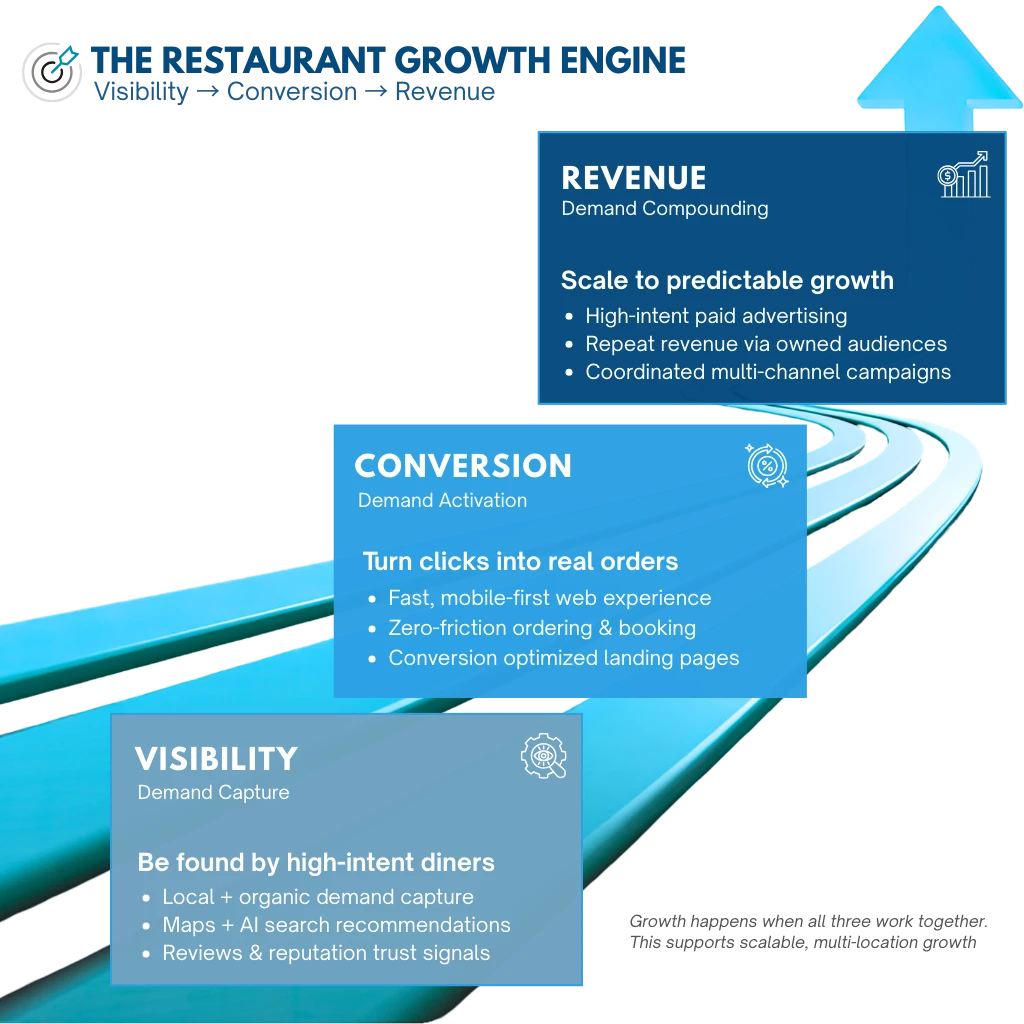
Our System-Driven Digital Marketing Framework
Growth happens when visibility, conversion, and revenue are intentionally designed to work together as one system.
Visibility
Demand Capture
Visibility is about being discovered at the moment of intent—when guests are actively choosing where to eat. This is where restaurant SEO services play a foundational role—because without visibility, nothing else works.
Conversion
Demand Activation
Conversion turns attention into action. Without it, traffic is wasted. That’s why growth marketing depends on restaurant website design built for conversion—not generic templates or brand-only design.
Revenue
Demand Compounding
Revenue growth comes from repeatability—not one-time wins. This is where momentum is built. This is where ongoing execution matters—and why restaurants partner with a Restaurant Marketing Agency that manages the system, not individual tasks.
Visibility → Conversion → Revenue
This structure allows brands to scale without recreating marketing from scratch every time a new location opens.
The Core Digital Marketing Channels for Restaurants
Each channel plays a specific role—but performance comes from how they connect, not how they’re managed individually.
Search Visibility (SEO, Maps & AI)
Search is still the primary discovery channel for restaurants—but it’s no longer limited to blue links. Visibility now spans Google Search, Google Maps, and AI-powered results that summarize and recommend restaurants. Strong search visibility ensures your brand appears where and how guests are actually looking.
Explore comprehensive restaurant SEO strategies →
Website Experience & Conversion
Your website is the conversion engine that turns attention into action. Speed, mobile usability, clear ordering paths, and trust signals all directly impact bookings, online orders, and guest engagement across every marketing channel.
See how we do conversion-first restaurant website design →
Paid Advertising & Campaigns
Paid media accelerates demand when it’s used strategically. Search ads, local campaigns, and social advertising help restaurants capture high-intent traffic, promote offers, and support new locations—without relying solely on organic reach.
Email, SMS & Guest Retention
Growth isn’t just about new guests—it’s about repeat visits. Email and SMS marketing support retention, promotions, loyalty, and lifecycle campaigns that keep your restaurant top-of-mind long after the first visit.
Social Content & Distribution
Social media supports visibility, brand recognition, and ongoing engagement. While it’s rarely the final conversion channel, social content reinforces demand, supports campaigns, and amplifies performance across search, paid media, and email.
Important: These channels are most effective when they work together—not when they’re managed in isolation.
Why Digital Marketing Channels Must Work Together
When digital marketing channels operate in silos, performance suffers. Traffic increases without conversions. Campaigns run without retention. Data exists, but insights don’t translate into action.
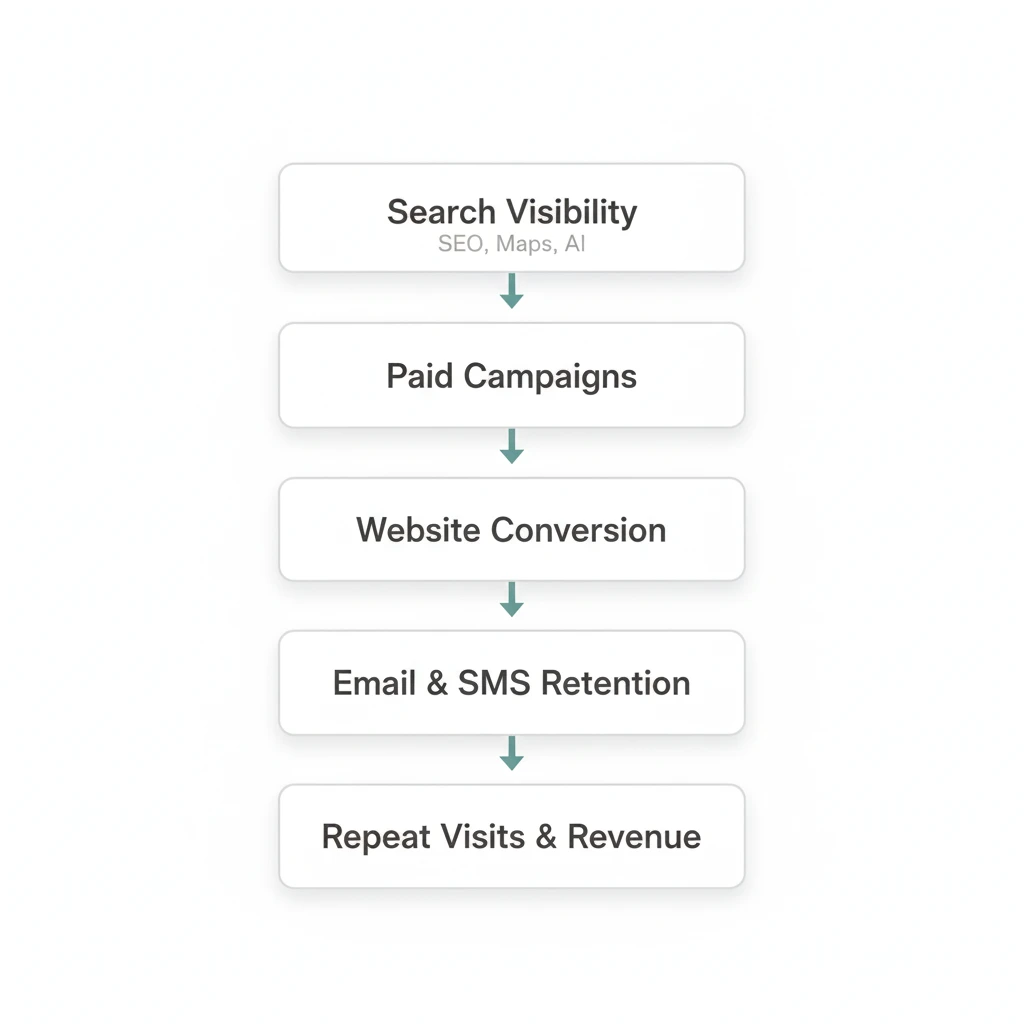
In 2026, successful restaurant marketing is built around coordination. Each channel supports the next—creating momentum instead of fragmentation.
Search visibility feeds paid campaigns. Paid campaigns drive traffic to high-performing websites. Websites convert guests into subscribers. Email and SMS drive repeat visits. Social content reinforces awareness across every stage.
When these systems are aligned, restaurants gain clarity, efficiency, and sustainable growth.
How Digital Marketing Differs for Single and Multi-Location Restaurants
Single-Location Restaurants
Single-location restaurants focus on efficiency and clarity. Marketing success depends on strong local visibility, consistent traffic, and turning first-time guests into regulars. Every dollar needs to work harder, and results must be easy to measure.
Digital marketing at this level prioritizes:
- Retention systems that encourage repeat visits
- Local search visibility and reputation
- Conversion-focused websites
- Simple campaigns that drive immediate demand
Multi-Location Restaurants
Multi-location brands face a different challenge: scale. Marketing must stay consistent across locations while allowing for local nuance. Visibility, reporting, and execution need structure—or complexity quickly becomes a liability.
Digital marketing for restaurant groups prioritizes:
- Systems that scale without multiplying effortfasdfasf
- Location-level visibility without cannibalization
- Centralized strategy with distributed execution
- Cross-location performance tracking
How This Fits Into Our Restaurant Marketing Agency Approach
Digital marketing works best when it’s part of a larger growth marketing system. Strategy, execution, reporting, and optimization need to move together—across channels and across locations
This guide explains what digital marketing for restaurants looks like in 2026. Our agency approach focuses on how those channels are planned, executed, and measured as one connected system – built to scale with your restaurant brand.