

Stop Paying 5% to Owner.com
Most restaurants are losing $2,000–$5,000 /month in fees and missed direct orders.
Before choosing an alternative, get clarity on:
- What you’re actually losing
- What switching really involves
- How to recover direct revenue without hurting SEO
Every month you delay = more revenue lost.
15–30 min consultation. No obligation.

Owner.com Alternatives for Restaurants
Owner.com is a popular platform… however, many restaurants evaluating Owner.com alternatives are looking for more control over SEO, website performance, and long-term growth.
However, as restaurants grow – or operate in more competitive markets – some begin to explore alternatives. Not because Owner.com is “bad,” but because their needs expand beyond a single platform into search visibility, conversion optimization, and long-term revenue growth. Restaurants researching Owner.com alternatives are typically comparing long-term SEO control, website ownership, and scalability — not just features.
This guide breaks down the best Owner.com alternatives — and when a growth system is the better choice.
Evaluating Owner.com alternatives?
This guide is for restaurants that want more flexibility than template-based websites and are looking to reduce ongoing platform fees or commission leakage by driving more direct orders.

Are You Replacing a Tool… or Trying to Grow Your Restaurant?
Owner.com Alternatives Explained
Most restaurant owners looking for Owner.com alternatives are trying to solve one of two problems: replacing a platform—or fixing growth. These are not the same decision.
Owner.com is a software platform. Most alternatives (Toast, ChowNow, Popmenu) are also platforms. They give you tools—but not necessarily outcomes.
Some restaurants, however, choose a different path: instead of replacing one tool with another, they move to a growth system that combines website, SEO, ads, and retention into one strategy.
This is where The Digital Restaurant fits — not as another platform, but as a growth-focused alternative designed to increase orders.
Top Owner.com Alternatives (2026)
Here are the most common Owner.com alternatives — including both software platforms and growth-focused approaches.
| Option | Type | Best For | Key Difference |
|---|---|---|---|
| Toast | Platform (POS + Ordering) | Multi-location, all-in-one ops | Full system integration |
| ChowNow | Platform (Ordering) | Direct online orders | Commission-free ordering |
| Popmenu | Platform (Marketing + Website) | Engagement + repeat customers | Built-in marketing tools |
| Square | Platform (Budget POS) | Small / startup restaurants | Simple + low cost |
| The Digital Restaurant | Growth System (Agency + Platform) | Restaurants focused on increasing direct orders and revenue | Combines website, SEO, ads, and retention into one system |
Most Owner.com alternatives focus on replacing software. The Digital Restaurant focuses on improving performance — increasing direct orders, visibility, and long-term revenue.
Why Restaurants Start Looking Beyond Owner.com
What usually changes as competition, expectations, and growth pressure increase
Owner.com is designed to simplify digital marketing for restaurants by combining website management, online ordering, and guest communication into a single platform. For many single-location restaurants, this approach offers speed and convenience. Over time, some operators begin exploring alternatives—not because Owner.com stops working, but because their business requirements evolve.
Many restaurant owners evaluating Owner.com alternatives are ultimately asking a deeper question: is Owner.com actually the best platform for long-term SEO control, website ownership, and scalable growth — or are there stronger competitors built for expansion?
Common reasons restaurants start comparing options include:
- Increased competition in local search and Google Maps
- Greater reliance on organic discovery and AI-powered recommendations
- The need for deeper SEO and location-level optimization
- Limitations in website performance or customization
- Scaling challenges for multi-location brands
- A desire for clearer attribution between marketing activity and revenue
At this stage, the question often shifts from “Which platform is easiest to use?” to “Which approach supports long-term growth?”
How Much Are You Losing?
If your restaurant is doing $40,000/month in online orders, a 5% fee = $2,000/month → $24,000/year lost
| Monthly Online Orders | 5% Fee (Monthly) | Revenue Lost (Annual) |
|---|---|---|
| $40,000 | $2,000 | $24,000 |
| $80,000 | $4,000 | $48,000 |
| $150,000 | $7,500 | $90,000 |
And this doesn’t include:
- Lost repeat customers
- Third-party dependency
- Missed direct order growth
Most restaurants underestimate this. Get a custom breakdown based on your numbers.
15–30 min consultation. No obligation.
Owner.com Fees, Contracts, and Common Questions
Key considerations restaurants weigh when evaluating platform fees, contracts, and long-term flexibility.
How Owner.com’s Service Fees Typically Work
Owner.com operates as a bundled platform, combining website management, online ordering, and marketing tools into a single system. Like many all-in-one platforms, its pricing model is designed to offset the cost of building, maintaining, and supporting that infrastructure. In some cases, this includes ongoing service fees that scale with usage or order volume. For restaurants just getting started, this structure can feel simple and convenient. As order volume increases, however, the cost impact becomes more noticeable and prompts closer evaluation.
Why Some Restaurants Look to Reduce or Avoid Ongoing Platform Fees
As restaurants grow, platform fees that once felt manageable can begin to affect margins—especially for concepts doing meaningful direct-order volume. Many operators start looking for ways to reduce ongoing fees in favor of more predictable costs, greater website ownership, and direct control over ordering experiences. This shift is usually driven by math and scale, not dissatisfaction. The larger the operation, the more important cost structure, flexibility, and long-term efficiency become.
Can Restaurants Eliminate Platform Fees Entirely?
In some cases, yes – but it depends on the model a restaurant chooses. Owning a website and ordering infrastructure can reduce or eliminate percentage-based platform fees, though it often introduces different tradeoffs around management, optimization, and marketing execution. There is no universal best option. The right approach depends on growth stage, internal resources, and long-term revenue goals.
Thinking About Canceling an Owner.com Contract?
Restaurants typically begin thinking about canceling an Owner.com contract when the platform no longer aligns with their growth goals. This may happen as fees add up, SEO progress stalls, or greater control over the website and ordering experience becomes necessary.
Before switching, it’s important to evaluate what comes next. Many operators move away from single-platform tools toward growth systems that prioritize ownership, search visibility, and long-term revenue—without commission-driven constraints.
What to Know Before Canceling or Switching from Owner.com?
Before making any changes, it’s important to understand what’s actually affected when you leave a platform like Owner.com. A smooth transition depends on planning—not urgency.
- Domain ownership
Confirm who controls your restaurant website domain registration, and hosting. Ownership determines how easily you can move without rebuilding from scratch.
Important Note: Your domain should be owned by your business—not managed or controlled by a platform or vendor. If a platform currently controls it, initiate a transfer to bring the domain under your ownership control. - Website portability & migration
Understand how your website is structured before switching platforms. With traditional CMS platforms (such as WordPress), website files and content are portable—meaning they can be hosted anywhere and retained indefinitely. In website builder platforms systems, the website exists only within the service itself.
Important note: In website builder platform models, there are no website files or databases to migrate. When the service ends, restaurants often need to rebuild their website on the next platform rather than transferring an existing site. - SEO continuity
Existing search rankings, indexed pages, and URLs should be preserved during any platform change. When a website must be rebuilt rather than migrated, SEO continuity depends on recreating critical content and implementing proper redirects to prevent sudden traffic loss.
Important note: When a website cannot be transferred as-is, failing to map old URLs to the new site can result in lost rankings, broken links, and reduced visibility—often requiring months to recover. - Customer data
Verify that you can export and retain full ownership of your customer data—including emails, phone numbers, order history, and loyalty records—before canceling. Losing access to customer data can permanently impact repeat business and revenue.
Important note: Customer data should always be owned by the business. Platforms may enable collection, but ownership and long-term access must remain with the restaurant. - Online ordering transition
Plan how direct orders will be handled during the switch so guests experience no interruption at checkout. - Timing and disruption
Coordinate changes carefully to avoid downtime during peak business periods.
Most problems restaurants face during platform switches come from unclear ownership and rushed migrations—not from the switch itself.
Switching platforms isn’t about moving fast—it’s about moving deliberately.
Losing revenue to Owner.com? See what you’re losing.
What Restaurants Should Actually Evaluate When Comparing Owner.com Alternatives
What truly impacts visibility, conversion, and long-term revenue growth
When restaurants compare Owner.com with other options, the real decision goes far beyond features or pricing tiers. Most operators searching for Owner.com alternatives are facing deeper growth challenges:
- Organic traffic has plateaued
- Google Maps visibility is inconsistent
- Third-party delivery fees continue to erode margins
- Multi-location performance varies widely
- Marketing efforts reset every month instead of compounding
The real question isn’t: “Which platform has more tools?”
It’s: “Which structure builds long-term visibility, conversion efficiency, and revenue momentum?”
If your goal is simply to replace Owner.com, a platform alternative may be enough. If your goal is to increase orders and revenue, a growth system approach is required.
Key Growth Factors to Evaluate
When comparing alternatives, restaurants should evaluate:
- Website performance and Core Web Vitals (speed, stability, mobile UX)
- Local SEO depth and Google Maps strength across all locations
- AI search visibility in platforms that summarize and recommend restaurants
- Open platform flexibility vs. closed ecosystems
- Direct ordering integration and commission control
- Conversion optimization beyond visual design
- Scalability across multiple locations and new openings
- Strategic guidance vs. DIY tool management
- Long-term ownership of website, data, and content assets
When evaluated through this lens, the difference becomes clearer:
Some platforms provide tools.
Others provide growth systems.
Understanding that distinction is what determines whether your digital presence compounds over time — or simply maintains status quo.
Owner.com vs Growth-System Alternatives: Key Structural Differences
Where platforms and growth systems fundamentally differ
While many platforms offer overlapping features, the biggest differences usually come down to flexibility, ownership, and how growth is supported over time.
| Area | Owner.com | Growth-System Approach |
|---|---|---|
| Platform | Proprietary, managed platform | Open platform (custom WordPress) |
| Ownership | Platform-dependent | Fully owned by the restaurant |
| SEO Depth | Limited, generalized | Advanced local + organic SEO |
| AI Search Visibility | Not a core focus | Built into strategy |
| Customization | Constrained by platform | Fully customizable |
| Conversion Optimization | Limited, Template-based | Ongoing CRO improvements |
| Multi-Location Support | Moderate | Built for scale and governance |
| Strategy & Guidance | Tool-led | Strategy-led |
| Long-Term Flexibility | Locked ecosystem | Open, adaptable stack |
Neither approach is universally “better”—the right choice depends on your restaurant’s growth stage and competitive environment.
When Owner.com Is the Right Choice
When simplicity and speed matter more than flexibility
Owner.com can be a fit for certain restaurants—especially when simplicity and speed are the top priorities.
Key factors to evaluate include:
- Operates a single location
- Serves a low-to-moderate competition market
- Wants an all-in-one platform with minimal setup
- Does not require deep SEO customization
- Is comfortable operating within a closed ecosystem
- Has a limited internal marketing team
- Prioritizes convenience over long-term flexibility
For restaurants at this stage, Owner.com can provide a practical way to establish a professional online presence without managing multiple vendors.
When Restaurants Choose a Growth System Instead of Owner.com
When performance, visibility, and scale become the priority
As restaurants grow, the limitations of tool-centric platforms become more visible. At this stage, many operators shift their focus from convenience to performance, visibility, and long-term revenue impact.
Restaurants often choose a growth-system approach when:
- Local search and Google Maps visibility directly affect demand
- AI-powered search and recommendations influence discovery
- Competition requires stronger SEO and conversion optimization
- The website must evolve beyond templates
- Multiple locations need consistent brand governance
- Marketing efforts must be tied to measurable revenue outcomes
- Leadership wants strategy and accountability—not just dashboards
In these scenarios, success depends less on the software itself and more on how strategy, execution, and optimization work together over time.
How The Digital Restaurant Approaches Restaurant Growth Differently
How strategy connects visibility, conversion, and revenue over time
The Digital Restaurant works with restaurants that have moved beyond tool-based solutions and need a structured and intentional approach to growth.
As brands scale, isolated tools—websites, ordering platforms, email software, ads—often stop compounding results. Visibility increases without conversion. Traffic grows without revenue impact. Marketing activity increases, but outcomes plateau.
Instead of selling disconnected tactics or standalone software, the focus is on building a complete restaurant growth system—one designed to connect visibility, conversion, and revenue into a single, measurable framework.
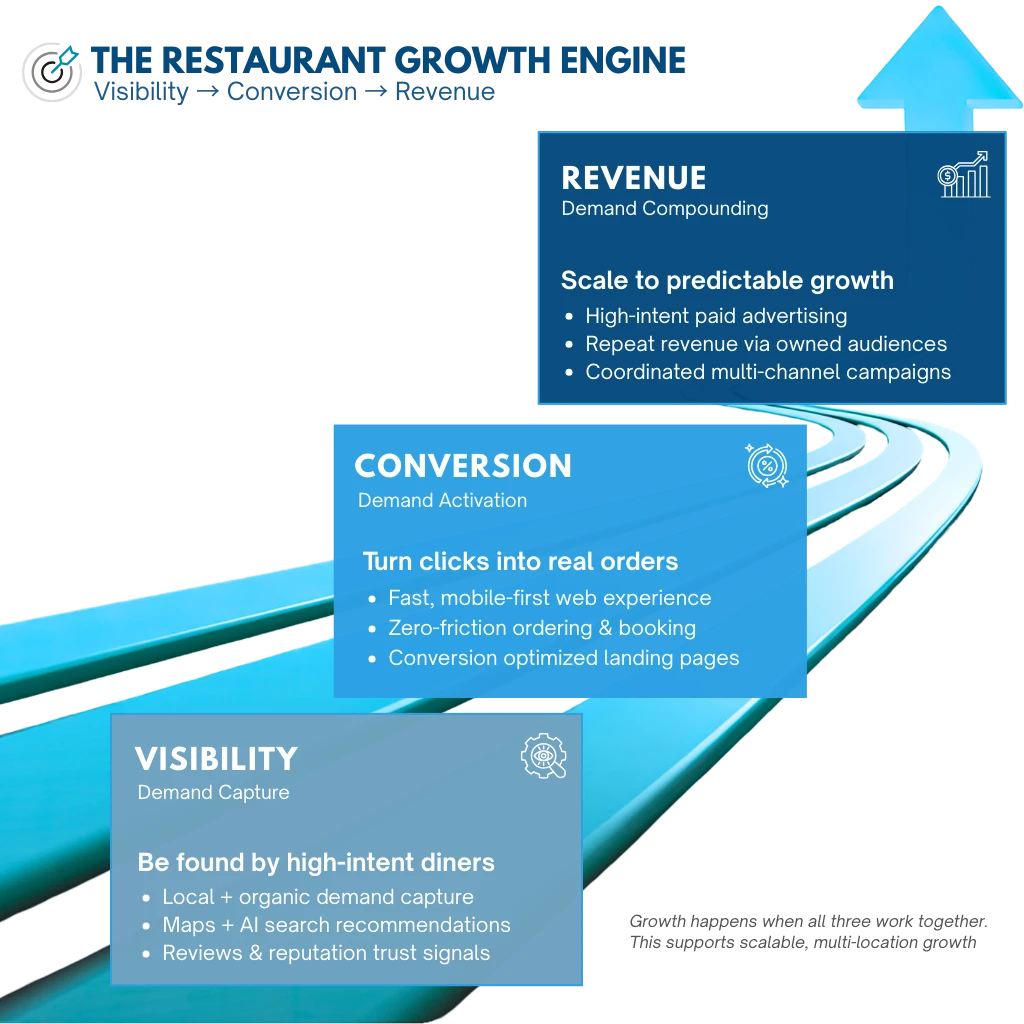
This approach typically includes:
- Diagnosing visibility and conversion gaps before execution
- Building fast, search-optimized websites restaurants fully own
- Strengthening local SEO, organic SEO, and AI search visibility
- Optimizing conversion paths for direct ordering
- Coordinating marketing activity across locations and channels
- Measuring performance based on outcomes, not activity
For restaurants evaluating Owner.com alternatives, this distinction—tool versus system—is often the deciding factor. Growth rarely stalls because a single tool is missing. It stalls when the system connecting everything together is incomplete.
What Happens When Restaurants Switch to a Growth System
Restaurants that move beyond platform-only solutions typically see measurable improvements across visibility, conversion, and revenue.
| Metric | Before (Typical Platform Setup) | After (Growth System Approach) |
|---|---|---|
| Direct online orders | Low / dependent on 3rd party | +20–50% increase |
| Page speed | 30–40 (slow builders) | 90+ (high-performance) |
| Google visibility | Limited | Top 3 local rankings |
| Conversion rate | Low (basic UX) | Higher (optimized flow) |
| Customer retention | Tool-based | Strategy-driven (email/SMS) |
One multi-location restaurant group saw a 38% increase in direct online orders within 90 days after moving from a platform-based setup to a unified growth system.
Which Option Is Right for Your Restaurant at Different Growth Stages?
A quick self-check to clarify your current growth stage
If you’re still evaluating different types of restaurant marketing platforms, this overview explains how the restaurant marketing platform categories differ and when each approach makes sense.
Choose a platform like Owner.com if:
- You want a fast, all-in-one solution
- You operate a single location
- Competition in search is moderate
- You prefer minimal customization
- Convenience is the top priority
Choose a growth-system approach if:
- Search visibility drives new guest demand
- You compete heavily in Google Maps, organic search and AI searches
- You operate multiple locations or plan to scale
- You want ownership and long-term flexibility
Both approaches can work—the right choice depends on your current stage and where you want the business to go next.
Making the Right Decision for Your Restaurant
How to move forward with clarity – without rushing a decision
If you’re actively comparing Owner.com alternatives, the most important question isn’t which platform has more features—it’s which approach supports your restaurant’s next stage of growth.
Learn how our restaurant growth system works →
View pricing and engagement models →
We work with restaurants that are ready to move beyond tools and invest in long-term visibility, conversion, and revenue growth.
Choosing the Right Restaurant Website & Marketing Platform
When evaluating alternatives to Owner.com, the decision should go beyond price or feature lists. The real difference comes down to long-term ownership, SEO continuity, and whether your marketing system can scale as your restaurant grows. Many platforms bundle tools together—but that doesn’t always translate into sustainable growth.
- Who owns your website and SEO rankings?
- Can you migrate platforms without losing traffic?
- Is your marketing strategy built for multi-location growth?
- Are you building a system—or renting software?
What Happens If You Switch?
We don’t just replace Owner.com.
We rebuild your growth system so you actually recover lost revenue:
- Website + direct ordering infrastructure
- SEO + AI visibility
- Conversion optimization
- Customer data ownership
No ranking loss. No disruption. No guesswork.
15–30 min consultation. No obligation.
FAQs
Is Owner.com the best platform for restaurants?
Owner.com provides an integrated website and ordering solution, but restaurants often compare it against broader restaurant marketing platforms that prioritize SEO depth, performance optimization, and long-term ownership of digital assets. The right choice depends on whether a restaurant is seeking convenience or scalable growth infrastructure.
Is Owner.com a good option for new restaurants?
Yes. Owner.com can be a good option for new or single-location restaurants that want a fast, bundled way to launch a website and online ordering with minimal setup. As competition or growth increases, some restaurants begin exploring alternatives that offer more flexibility, deeper SEO, and long-term ownership.
Why do restaurants look for Owner.com alternatives?
Restaurants typically look for Owner.com alternatives as they grow, face more competition, or need greater flexibility in SEO, website performance, and direct-order optimization.
What should restaurants compare when evaluating Owner.com alternatives?
Beyond features, restaurants should compare website ownership, SEO depth, local and AI search visibility, conversion optimization, flexibility of the platform, and how well each option supports long-term growth rather than short-term setup.
Are Owner.com alternatives more expensive?
Owner.com alternatives are not always more expensive, but they often shift costs away from bundled platform fees or commissions toward owned infrastructure and long-term growth investment.
When does a growth-system approach make more sense than a platform?
A growth-system approach typically makes more sense when a restaurant wants to own its website, improve search visibility, reduce reliance on commissions, and support long-term revenue growth.
What are the main limitations of template-based restaurant websites?
Template-based restaurant websites often limit customization, advanced SEO control, performance optimization, and long-term flexibility as a restaurant’s needs evolve.
Does Owner.com charge a 5% fee?
Owner.com does not publicly list a flat 5% platform fee. However, some restaurants report that total costs can approach this level once payment processing and related services are included, depending on plan and order volume.
Why do restaurants look for Owner.com alternatives as they grow?
Restaurants often look for alternatives when growth requires more control over website performance, SEO, and data ownership. As traffic and direct orders increase, some operators find that platform limitations around speed optimization, location-level SEO, and flexibility can restrict long-term visibility and scalability.
How does Owner.com impact SEO and AI search visibility for restaurants?
Website platforms influence how restaurants appear in Google Search, Google Maps, and AI-generated results. Platforms that limit structured data, advanced SEO controls, or page-level optimization can reduce both traditional rankings and how restaurants are summarized or recommended by AI search tools.
What should restaurants consider before canceling Owner.com?
Before canceling Owner.com, restaurants should evaluate website ownership, SEO continuity, ordering transitions, and whether their next solution supports long-term growth rather than just platform convenience.
Explore All Restaurant Marketing Platform Comparisons
If you’re evaluating Owner.com, it’s helpful to understand how different restaurant marketing platforms are structured — from website-first tools to full growth systems.
See our complete breakdown of restaurant marketing platforms and how they compare across ownership, SEO continuity, direct ordering control, and long-term scalability.
→ Explore the Restaurant Marketing Platforms Comparison Guide