

PopMENU Alternatives for Restaurants
Popmenu is a well-known platform used by restaurants to manage menu presentation and guest engagement, often chosen for its fast, bundled setup.
Over time, some restaurants begin evaluating Popmenu alternatives – not because Popmenu stops working, but because priorities shift. As competition increases or growth goals change, operators often need deeper search visibility, more control over their website, or a broader growth strategy beyond menu marketing. Restaurants comparing Popmenu vs competitors are often evaluating long-term value for price — not just visual menu features.
This comparison is designed to help restaurant owners evaluate when Popmenu makes sense—and when alternative approaches may better support long-term growth.
Evaluating Popmenu alternatives?
This guide is for restaurants that have outgrown templates and want more control over SEO, performance, and direct-order growth—without jumping platforms blindly.

Why Restaurants Look Beyond Popmenu
Why growing restaurants start re-evaluating menu-first marketing platforms
Popmenu is designed to help restaurants showcase menus and engage guests more effectively. For many, this solves an immediate need—especially around menu visibility and presentation.
As restaurants grow or compete in more crowded markets, some operators begin looking beyond menu-focused platforms. The shift usually isn’t about dissatisfaction, but about expanding needs across search visibility, website performance, and revenue impact.
Common reasons restaurants start comparing options include:
- Limited control over website structure and technical SEO
- Template-based layouts that restrict performance optimization
- Marketing tools focused on engagement, not revenue growth
- Difficulty integrating a long-term growth strategy across channels
At this stage, the question shifts from “Is Popmenu easy to use?” to “Will this platform support long-term growth?”. This shift is rarely about dissatisfaction – it’s about hitting a growth ceiling as competition increases.
What to Evaluate When Comparing Popmenu Alternatives
What matters once menu presentation is no longer the only priority
When restaurants compare Popmenu with other options, the differences often extend beyond menu design or guest engagement tools. The real question becomes how well each approach supports visibility, conversion, and revenue across the entire digital experience. This comparison fits within a broader set of restaurant marketing platform categories, each designed for different stages of growth.
Key factors to evaluate include:
- Website ownership and long-term flexibility
- SEO strength beyond menu pages
- Local search and Google Maps visibility
- AI search visibility where restaurants are summarized and recommended
- Website speed, mobile usability, and Core Web Vitals
- Conversion paths from discovery to direct ordering
- Multi-location scalability and brand governance
- Strategic guidance versus tool-only execution
- Ability to connect marketing activity to revenue outcomes
Evaluating alternatives through this lens helps clarify whether a platform supports menu marketing—or full-funnel restaurant growth.
Popmenu Limitations Restaurants Commonly Encounter
When performance, visibility, and scale become the priority
Popmenu works well for restaurants that want fast deployment and bundled engagement tools. However, some operators begin to experience limitations as their marketing needs mature. These typically include reduced flexibility in site performance optimization, limited SEO customization, and challenges scaling beyond engagement-focused features into a full growth system.
How Does Popmenu Compare to Competitors on Value and Pricing?
When restaurants compare Popmenu vs competitors, the conversation often centers on value for price — not just features. Operators evaluate what they are receiving in exchange for monthly platform fees, including SEO control, website ownership, conversion optimization, and scalability.
Some restaurants prioritize bundled convenience. Others look more closely at long-term return on investment, performance flexibility, and growth infrastructure beyond presentation tools.
Understanding the structural differences between Popmenu and broader restaurant marketing platforms helps clarify whether the pricing aligns with long-term revenue goals.
Popmenu vs Growth-System Alternatives
Where menu-first platforms and growth systems fundamentally differ
Popmenu focuses on menu presentation and guest engagement. Growth-system alternatives focus on how the entire digital presence performs—from discovery to revenue.
| Area | Popmenu | Growth-System Approach |
|---|---|---|
| Primary Focus | Menu presentation & engagement | End-to-end growth (visibility → conversion → revenue) |
| Ownership | Platform-bound | Fully owned by the restaurant |
| SEO Depth | Limited optimization | Advanced local + organic SEO |
| Google Maps Visibility | Not a core focus | Core strategic priority |
| AI Search Visibility | Not emphasized | Built into strategy |
| Website Performance (CWV) | Constrained by platform | Actively optimized |
| Conversion Optimization | Menu interaction–focused | Full-funnel CRO |
| Multi-Location Governance | Moderate | Built for scale |
| Strategic Guidance | Tool-led | Strategy-led |
| Long-Term Flexibility | Closed ecosystem | Open, adaptable stack |
For restaurants evaluating Popmenu alternatives, the decision typically comes down to whether you need a bundled platform—or a growth system designed for visibility, performance, and long-term demand.
When Restaurants Choose a Growth System Instead
When performance, visibility, and scale become the priority
As restaurants grow, menu engagement is only one part of the equation. At this stage, many operators shift their focus to how guests discover the restaurant, how effectively traffic converts to orders, and how performance scales over time.
Restaurants often choose a growth-system approach when:
- Local search and Google Maps visibility drive demand
- SEO beyond menu pages impacts discovery
- AI-powered search and recommendations influence where guests choose to eat
- Website speed, structure, and conversion paths affect revenue
- Multiple locations require centralized governance
- Leadership wants marketing activity tied to measurable outcomes
In these scenarios, a growth-system approach provides the structure and flexibility needed to support long-term restaurant growth.
How The Digital Restaurant Approaches Restaurant Growth
How strategy connects visibility, conversion, and revenue beyond menu marketing
The Digital Restaurant takes a different approach as a restaurant growth marketing agency – focusing on systems, not disconnected tools.
Rather than focusing on a single tool or feature, the emphasis is on building a complete growth system—one that aligns search visibility, website performance, and conversion optimization with revenue goals.
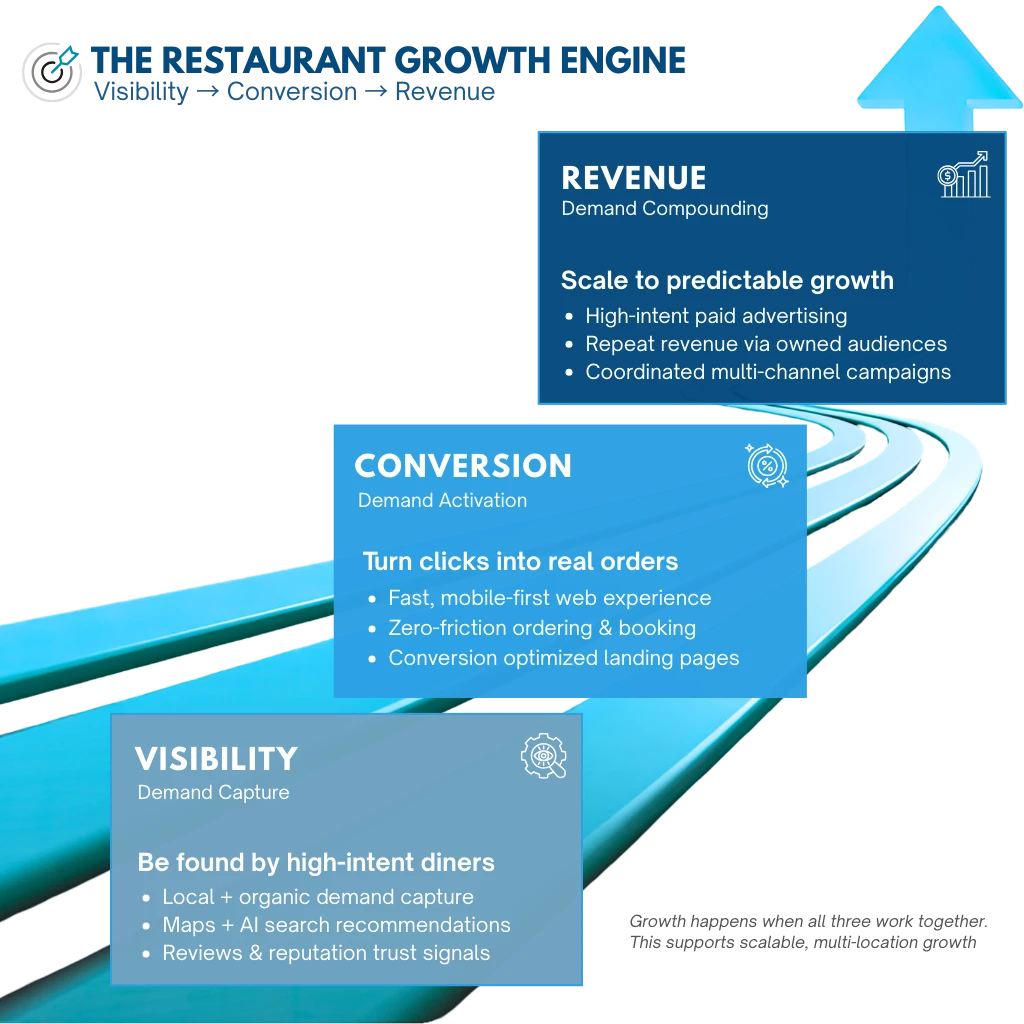
This approach typically includes:
- Diagnosing visibility and performance gaps before execution
- Building fast, search-optimized websites that restaurants fully own
- Strengthening local SEO, organic SEO, and AI search visibility
- Optimizing conversion paths from discovery to direct ordering
- Supporting multi-location governance and consistency
- Measuring success based on outcomes, not activity
For restaurants comparing Popmenu alternatives, this distinction—menu platform versus growth system—is often the deciding factor.
Which Option Is Right for Your Restaurant?
A quick self-check to clarify your current growth stage
Choose a platform like Popmenu if:
- Menu presentation is the primary digital priority
- You want a fast, bundled setup
- Competition in search is moderate
- SEO beyond menu pages is not a focus
- You prefer minimal customization
- Simplicity matters more than flexibility
Choose a growth-system approach if:
- Search visibility drives guest demand
- Google Maps and organic rankings impact revenue
- AI search visibility is becoming important
- Website performance and CRO affect orders
- You operate or plan to scale multiple locations
- You want ownership and long-term flexibility
Many restaurants start with menu-focused platforms and intentionally move to a growth-system approach as the business evolves.
Making the Right Decision for Your Restaurant
How to move forward with clarity – without rushing a decision
If you’re comparing Popmenu alternatives, the most important decision isn’t about tools—it’s about choosing an approach that supports where your restaurant is headed next.
Learn how our restaurant growth system works →
View pricing and engagement models →
We work with restaurants that are ready to move beyond tools and invest in long-term visibility, conversion, and revenue growth.
Choosing the Right Restaurant Website & Marketing Platform
When evaluating alternatives to Popmenu, the decision should go beyond price or feature lists. The real difference comes down to long-term ownership, SEO continuity, and whether your marketing system can scale as your restaurant grows. Many platforms bundle tools together—but that doesn’t always translate into sustainable growth.
- Who owns your website and SEO rankings?
- Can you migrate platforms without losing traffic?
- Is your marketing strategy built for multi-location growth?
- Are you building a system—or renting software?
In Summary: Choosing the Right Popmenu Alternative
Popmenu can be a practical bundled solution for restaurants that want a fast, all-in-one website and marketing setup, but as brands grow or operate in more competitive markets, deeper SEO strength, stronger website performance, multi-location scalability, and long-term ownership become more important than convenience alone. Ultimately, the decision isn’t about features—it’s about whether you’re choosing a software platform or building a long-term growth system that supports sustained visibility, control, and revenue expansion.
FAQs
Is Popmenu a good choice for restaurants?
Popmenu can be a good fit for restaurants that want to improve menu presentation and guest engagement without managing a complex marketing stack. It is often used by single-location restaurants or those with modest competition.
Why do restaurants look for Popmenu alternatives?
Restaurants typically explore alternatives when menu engagement alone is no longer enough. Common reasons include the need for stronger SEO, better Google Maps visibility, improved website performance, or a broader strategy tied to revenue growth.
What should restaurants compare when evaluating Popmenu alternatives?
Beyond menu features, restaurants should compare website ownership, SEO depth beyond menu pages, local and AI search visibility, conversion optimization, scalability for multiple locations, and how marketing efforts connect to revenue.
Are Popmenu alternatives more expensive?
Not necessarily. Some alternatives involve higher upfront investment but offer greater long-term value through improved visibility, performance, and ownership of digital assets. The right choice depends on goals, competition, and growth stage.
When does a growth-system approach make more sense than a menu platform?
A growth-system approach typically makes sense when search visibility drives demand, competition is high, multiple locations are involved, or leadership wants marketing performance measured by outcomes rather than engagement alone.
Is Popmenu bad for SEO?
Popmenu supports basic SEO, but template-based platforms often limit technical optimization, site performance tuning, and advanced content strategies. For restaurants in competitive markets, this can cap long-term organic growth.
Are Popmenu alternatives better for SEO?
Popmenu works well for menu presentation and guest engagement, but restaurants in competitive markets often choose alternatives that offer deeper SEO control, faster website performance, and greater flexibility as they scale.
Why do restaurants evaluate Popmenu alternatives over time?
Restaurants typically explore alternatives when marketing priorities shift toward performance, search visibility, and conversion optimization. While template-based platforms offer simplicity, growing restaurants often require deeper SEO control, faster page speeds, and greater flexibility to compete in search and AI-driven discovery.
How do website platforms like Popmenu affect AI search recommendations?
AI search systems rely on website structure, content clarity, and technical signals such as page speed and structured data. Platforms that restrict customization or location-specific content can limit how accurately restaurants are represented or recommended in AI-powered search experiences.
See How Popmenu Fits Into the Platform Spectrum
Popmenu is one type of restaurant marketing platform — but restaurants today are choosing between very different structural approaches.
To understand how Popmenu compares to website-first, menu-first, promotion-first, and growth-system models:
→ Review the Restaurant Marketing Platforms Comparison Guide