

SpotHopper Alternatives for Restaurants
SpotHopper is a widely used platform for restaurant websites and guest engagement, often chosen for its quick setup and bundled features.
Over time, some restaurants begin comparing alternatives—not because SpotHopper stops working, but because growth introduces new priorities. Restaurants comparing SpotHopper alternatives are often evaluating whether bundled website platforms provide enough SEO depth and scalability — or if broader growth-system competitors offer more long-term flexibility.
This comparison is designed to help restaurant owners understand when SpotHopper makes sense—and when alternative approaches may better support long-term growth.

Why Restaurants Look Beyond SpotHopper
Why growing restaurants start re-evaluating promotion-first platforms
SpotHopper is one example of a promotion-first platform. Other restaurant marketing platforms are designed around very different priorities.
SpotHopper is designed to help restaurants launch quickly, promote offers, and engage guests without managing a complex marketing stack. For many operators, this solves an immediate need.
As restaurants grow or face stronger competition, some begin looking beyond promotion-focused platforms. The shift usually isn’t about dissatisfaction—it’s about evolving priorities across search visibility, website performance, and measurable revenue impact.
Common reasons restaurants start comparing options include:
- Increased competition in Google Search and Google Maps
- The need for stronger SEO beyond promotional pages
- Limited control over website performance and structure
- Difficulty tying promotions to sustained revenue growth
- Multi-location complexity and brand consistency challenges
- Desire for a broader growth strategy beyond campaigns
At this stage, restaurants often move from asking “How do we promote?” to “How do we grow consistently?”
What Restaurants Should Actually Evaluate When Comparing SpotHopper Alternatives
What truly impacts visibility, conversion, and long-term revenue growth
When restaurants compare SpotHopper with other options, the real decision goes far beyond features or pricing tiers. Most operators searching for SpotHopper alternatives are facing deeper growth challenges:
- Organic traffic has plateaued
- Google Maps visibility is inconsistent
- Third-party delivery fees continue to erode margins
- Multi-location performance varies widely
- Marketing efforts reset every month instead of compounding
The real question isn’t: “Which platform has more tools?”
It’s: “Which structure builds long-term visibility, conversion efficiency, and revenue momentum?”
Key Growth Factors to Evaluate
When comparing alternatives, restaurants should evaluate:
- Website performance and Core Web Vitals (speed, stability, mobile UX)
- Local SEO depth and Google Maps strength across all locations
- AI search visibility in platforms that summarize and recommend restaurants
- Open platform flexibility vs. closed ecosystems
- Direct ordering integration and commission control
- Conversion optimization beyond visual design
- Scalability across multiple locations and new openings
- Strategic guidance vs. DIY tool management
- Long-term ownership of website, data, and content assets
When evaluated through this lens, the difference becomes clearer:
Some platforms provide tools.
Others provide growth systems.
Understanding that distinction is what determines whether your digital presence compounds over time — or simply maintains status quo.
SpotHopper vs Growth-System Alternatives: : Key Structural Differences
Where promotion-first platforms and growth systems fundamentally differ
SpotHopper emphasizes promotions and guest engagement. Growth-system alternatives focus on how the entire digital presence performs—from discovery to revenue.
| Area | SpotHopper | Growth-System Approach |
|---|---|---|
| Primary Focus | Promotions & engagement | End-to-end growth (visibility → conversion → revenue) |
| Website Ownership | Platform-dependent | Fully owned by the restaurant |
| SEO Depth | Limited beyond promo pages | Advanced local + organic SEO |
| Google Maps Visibility | Not a core focus | Core strategic priority |
| AI Search Visibility | Not emphasized | Built into strategy |
| Website Performance (CWV) | Constrained by platform | Actively optimized |
| Conversion Optimization | Campaign-focused | Full-funnel CRO |
| Multi-Location Governance | Moderate | Built for scale |
| Strategic Guidance | Tool-led | Strategy-led |
| Long-Term Flexibility | Closed ecosystem | Open, adaptable stack |
The right choice depends on whether short-term promotions drive results—or whether sustained visibility and performance fuel long-term growth.
When SpotHopper Is the Right Choice
When simplicity and speed matter When promotions and quick execution are the priority than flexibility
SpotHopper can be a good fit for restaurants that want to launch quickly, run promotions, and engage guests without managing multiple tools or vendors.
Key factors to evaluate include:
- Promotions and offers are the primary marketing lever
- Fast setup is more important than customization
- Competition in search is moderate
- SEO beyond promotional pages is not a priority
- A bundled platform is preferred over flexibility
- The restaurant operates a single location or a small number of locations
For restaurants at this stage, SpotHopper provides a practical way to execute campaigns and guest engagement with minimal overhead.
When Restaurants Choose a Growth System Instead
When visibility, performance, and revenue outcomes matter more than promotions alone
As restaurants grow, promotions alone are rarely enough to sustain momentum. At this stage, operators often shift focus to how guests discover the restaurant, how effectively traffic converts to orders, and how performance scales over time.
Restaurants often choose a growth-system approach when:
- Local search and Google Maps visibility drive consistent demand
- SEO beyond promotional pages impacts discovery
- AI-powered search and recommendations influence where guests choose to eat
- Website speed, structure, and conversion paths affect revenue
- Multiple locations require centralized governance
- Leadership wants marketing efforts tied to measurable outcomes
In these scenarios, a growth-system approach provides the structure and flexibility needed to support long-term restaurant growth.
How The Digital Restaurant Approaches Restaurant Growth
How strategy connects visibility, conversion, and revenue beyond promotions
The Digital Restaurant works with restaurants that have moved beyond promotion-first platforms and need a structured approach to growth.
Rather than relying on campaigns alone, the focus is on building a complete growth system—one that aligns search visibility, website performance, and conversion optimization with revenue goals.
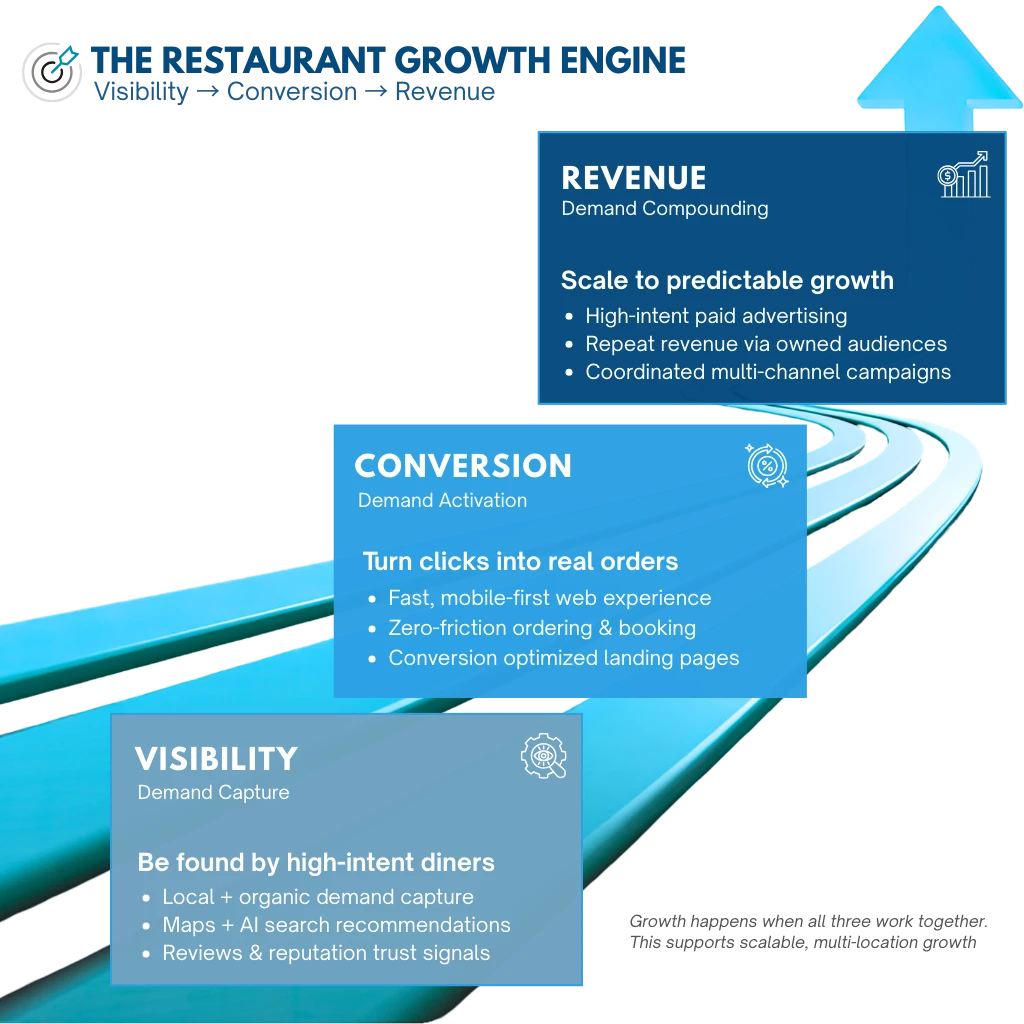
This approach typically includes:
- Diagnosing visibility and performance gaps before execution
- Building fast, search-optimized websites that restaurants fully own
- Strengthening local SEO, organic SEO, and AI search visibility
- Optimizing conversion paths from discovery to direct ordering
- Supporting multi-location governance and consistency
- Measuring success based on outcomes, not activity
For restaurants comparing SpotHopper alternatives, this distinction—promotion platform versus growth system—is often the deciding factor.
Which Option Is Right for Your Restaurant?
A quick self-check to clarify your current growth stage
Choose a platform like SpotHopper if:
- Promotions are the primary marketing driver
- You want fast execution with minimal setup
- Competition in search is moderate
- SEO beyond promotional pages is not a focus
- You prefer a bundled, all-in-one approach
- Simplicity matters more than flexibility
Choose a growth-system approach if:
- Search visibility drives guest demand
- Google Maps and organic rankings impact revenue
- AI search visibility is becoming important
- Website performance and CRO affect orders
- You operate or plan to scale multiple locations
- You want ownership and long-term flexibility
Many restaurants start with promotion-focused platforms and intentionally move to a growth-system approach as the business evolves.
Making the Right Decision for Your Restaurant
How to move forward with clarity – without rushing a decision
If you’re comparing SpotHopper alternatives, the most important decision isn’t about promotions—it’s about choosing an approach that supports where your restaurant is headed next.
Learn how our restaurant growth system works →
View pricing and engagement models →
We work with restaurants that are ready to move beyond tools and invest in long-term visibility, conversion, and revenue growth.
Choosing the Right Restaurant Website & Marketing Platform
When evaluating alternatives to SpotHopper, the decision should go beyond price or feature lists. The real difference comes down to long-term ownership, SEO continuity, and whether your marketing system can scale as your restaurant grows. Many platforms bundle tools together—but that doesn’t always translate into sustainable growth.
- Who owns your website and SEO rankings?
- Can you migrate platforms without losing traffic?
- Is your marketing strategy built for multi-location growth?
- Are you building a system—or renting software?
Is SpotHopper the Right Platform for Long-Term Growth?
SpotHopper can be a practical solution for restaurants that want an all-in-one website, ordering, and promotion platform. For single-location restaurants seeking convenience and bundled features, it may provide a structured starting point.
However, restaurants comparing SpotHopper alternatives often begin evaluating deeper questions around SEO performance, website ownership, and long-term scalability. As competition increases or brands expand into multi-location growth, some operators explore SpotHopper competitors that offer greater flexibility, stronger search visibility control, and a more integrated growth strategy beyond bundled tools.
The right choice depends on whether your priority is platform convenience — or building a system designed to compound visibility and revenue over time.
In Summary: Choosing the Right SpotHopper Alternative
SpotHopper can be a practical bundled solution for restaurants that want a fast, all-in-one website and marketing setup, but as brands grow or operate in more competitive markets, deeper SEO strength, stronger website performance, multi-location scalability, and long-term ownership become more important than convenience alone. Ultimately, the decision isn’t about features—it’s about whether you’re choosing a software platform or building a long-term growth system that supports sustained visibility, control, and revenue expansion.
FAQs
Is SpotHopper a good choice for restaurants?
SpotHopper can be a good fit for restaurants that want to launch quickly, run promotions, and engage guests without managing multiple tools. It’s often used by single-location restaurants or those with moderate competition.
Why do restaurants look for SpotHopper alternatives?
Restaurants typically explore alternatives when promotions alone are no longer enough. Common reasons include the need for stronger SEO, better Google Maps visibility, improved website performance, or a strategy tied more directly to revenue growth.
What should restaurants compare when evaluating SpotHopper alternatives?
Beyond promotions, restaurants should compare website ownership, SEO depth beyond promotional pages, local and AI search visibility, conversion optimization, scalability for multiple locations, and how marketing efforts connect to revenue.
Are SpotHopper alternatives more expensive?
Not necessarily. Some alternatives involve higher upfront investment but deliver greater long-term value through improved visibility, performance, and ownership of digital assets. The right choice depends on goals and growth stage.
When does a growth-system approach make more sense than a promotion platform?
A growth-system approach typically makes sense when search visibility drives demand, competition is high, multiple locations are involved, or leadership wants marketing performance measured by outcomes rather than campaigns alone.
Compare SpotHopper Within the Bigger Platform Landscape
SpotHopper fits into a broader category of restaurant website and marketing platforms. But not all platforms are built the same — some focus on bundled tools, others on long-term growth systems.
If you want a clearer view of how SpotHopper compares across platform categories, ownership models, SEO structure, and scalability: