
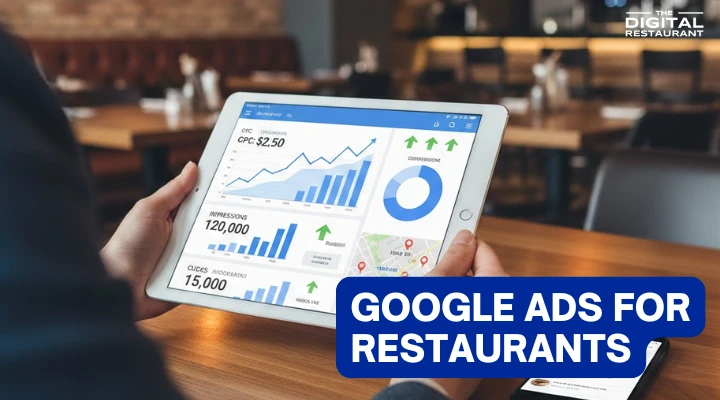
Restaurant advertising on Google can be one of the fastest ways to increase visibility and revenue — when executed strategically.
But most Google Ads campaigns for restaurants fail for a simple reason: they are managed like generic PPC accounts instead of local demand-capture systems.
Restaurants don’t need more clicks.
They need measurable revenue growth.
This guide explains how Google Ads for restaurants should be structured, what budgets make sense, and how to measure ROI properly.
Why Google Ads for Restaurants Requires a Specialized Approach
Restaurant PPC campaigns operate in a highly localized, intent-driven environment.
Unlike eCommerce brands, restaurants rely on:
- “Near me” searches
- Cuisine-specific discovery
- Mobile-first traffic
- Peak-hour demand cycles
- Direction and call extensions
A successful Google Ads strategy for restaurants must account for:
- Hyper-local targeting
- Branded vs non-branded keyword segmentation
- Daypart scheduling
- Negative keyword refinement
- Conversion tracking tied to actual revenue
Without these elements, ad spend becomes waste.
How to Structure Google Ads for Restaurants
01
Branded Campaigns
Capture searches for your restaurant name and protect against competitors bidding on your brand.
02
High-Intent Non-Branded Campaigns
Target phrases like:
- “Best pizza near me”
- “Mexican restaurant downtown”
- “Brunch spots open now”
These are revenue-generating keywords.
03
Location & Call Extensions
Enable:
- Click-to-call
- Directions
- Location mapping
These drive real-world visits.
04
Conversion Tracking
Track:
- Online orders
- Reservations
- Phone calls
- Direction clicks
Clicks mean nothing without revenue attribution.
How Much Should Restaurants Spend on Google Ads?
If you’re trying to determine the right overall investment level, our breakdown of restaurant advertising budgets explains how to calculate sustainable spend based on margin and acquisition cost.
There is no universal “correct” budget for restaurant advertising.
Google Ads investment should be based on economics — not guesswork.
Budget depends on:
- Market competition (major metro vs small town)
- Cuisine competitiveness (pizza vs niche specialty)
- Location density and proximity targeting
- Average order value (AOV)
- Customer lifetime value (LTV)
- Margin structure
As a starting reference:
Small independent restaurants often begin between $1,000–$3,000 per month in ad spend.
Multi-location restaurant groups may invest significantly more, especially when expanding into new markets or defending against competitive bidding.
But the more important question is not “How much should we spend?”
It’s:
What can we afford to pay to acquire a customer profitably?
For example: If your average order value is $40 and your contribution margin allows $12–$15 per acquisition, then your campaigns must be structured to maintain cost per order within that range.
Otherwise, increased traffic becomes expensive visibility — not growth.
Ad spend should never be determined in isolation.
It must align with:
- Conversion rate optimization
- Website performance and speed
- Menu clarity and pricing strategy
- Reputation strength (ratings influence click-through rates)
- Accurate conversion tracking
When these factors are aligned, advertising becomes predictable.
When they are not, budget increases rarely produce proportional revenue gains.
How to Measure ROI from Restaurant Google Ads
The most common mistake in restaurant PPC is focusing on:
- Click-through rate
- Cost per click
- Impressions
Instead, performance should be measured by:
- Cost per order
- Cost per reservation
- Revenue per campaign
- Return on ad spend (ROAS)
Advertising becomes predictable when tied to revenue tracking — not vanity metrics.
Google Ads vs SEO for Restaurants
Google Ads and SEO serve different — but complementary — roles in restaurant growth.
Google Ads captures existing demand.
When someone searches “best sushi near me” or “Italian restaurant open now,” paid search allows you to appear immediately at the top of results. It’s fast, controllable, and scalable — but it requires consistent budget.
SEO, on the other hand, builds long-term visibility.
By optimizing your website, local listings, and content, you earn organic rankings that continue generating traffic without paying for every click. SEO compounds over time, strengthening your authority in local search and AI-driven results.
The trade-off is speed vs durability.
- Google Ads = Immediate visibility, fast feedback, direct demand capture
- SEO = Sustainable rankings, lower long-term cost per acquisition, authority growth
The most effective restaurant growth strategies do not choose one over the other. They integrate both.
Paid search accelerates results while SEO builds defensibility.
Advertising brings traffic now. SEO ensures you don’t have to keep paying for the same visibility forever.
When aligned correctly, Google Ads and SEO create stability, scalability, and predictable revenue growth.
If you’re evaluating how paid search fits into your broader marketing system, explore how our restaurant advertising strategy integrates visibility, conversion, and long-term growth.
Is Google Ads Right for Every Restaurant?
Google Ads can be extremely effective — but it is not automatically the right move for every restaurant at every stage.
Google Ads works best when:
- There is consistent local search demand for your cuisine or category
- The restaurant has clear positioning (not “everything for everyone”)
- Conversion tracking is properly configured for orders, calls, and reservations
- The website loads quickly and is optimized for mobile users
- Margins can support paid customer acquisition
In these situations, paid search can scale visibility quickly and generate measurable revenue.
However, Google Ads may not be the right starting point if:
- Operational issues are driving negative reviews
- The website experience is weak or outdated
- Online ordering is confusing or unreliable
- Menu pricing leaves little room for customer acquisition cost
- There is limited search demand in the local market
Advertising amplifies existing strengths.
It also exposes weaknesses faster.
If fundamentals are broken, paid traffic simply increases the speed at which budget is lost.
The most effective restaurant advertising strategies begin with a simple question:
“Are we ready to scale — or do we need to fix core issues first?”
When the foundation is strong, Google Ads becomes an accelerator.
When the foundation is weak, it becomes a magnifier of problems.
Turning Paid Search Into Predictable Growth
Google Ads for restaurants should not operate in isolation.
When aligned with SEO, reputation signals, and conversion optimization, paid search becomes part of a broader restaurant advertising system — one designed for sustainable growth rather than short-term spikes.
If you’re exploring structured restaurant advertising services, ensure your strategy connects visibility, conversion, and measurable revenue outcomes.
Turn Restaurant Marketing Ideas
Into Predictable Growth
Successful restaurant brands don’t grow by stacking tactics.
They grow by running a connected growth system that turns visibility into orders – and first-time guests into repeat customers.
01
Diagnose visibility gaps
Identify where Google Maps, SEO, and AI search visibility are leaking demand today.
02
Fix conversion bottlenecks
Optimize website, menu, and direct ordering so web traffic actually turns into orders.
03
Scale repeat revenue
Use guest data (Email, SMS) to increase frequency, lifetime value, and predictable growth.
Built for serious operators – not one-off campaigns.
Leave a Reply