
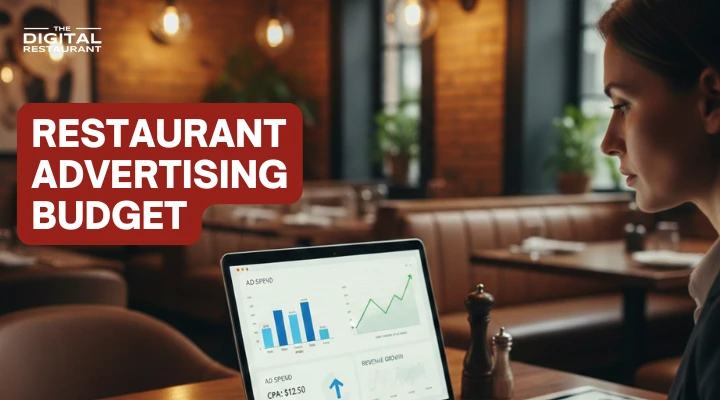
Most restaurant owners approach advertising budgets backwards.
They start by asking:
“How much should we spend?”
The more important question is:
“How much can we spend profitably to acquire a customer?”
Restaurant advertising budgets should be built on unit economics — not arbitrary percentages, not competitor behavior, and not guesswork.
Before deciding on ad spend, restaurant operators must understand:
- Average order value
- Contribution margin
- Customer acquisition cost tolerance
- Competitive intensity in their market
Without this clarity, increasing ad spend simply increases financial risk.
This guide explains how to calculate a sustainable advertising budget based on margin, market dynamics, and growth objectives.
If you’re evaluating paid search specifically, see our guide to Google Ads for restaurants to understand campaign structure and cost drivers.
TThe “3%–8% Rule” — And Why It’s Incomplete
You’ve likely heard that restaurants should spend between 3% and 8% of gross revenue on marketing.
While this rule provides a rough benchmark, it lacks operational context.
For example:
A restaurant generating $1,000,000 in annual revenue
spending 5% would allocate $50,000 per year to marketing.
But that number alone does not answer critical questions:
- How competitive is the local market?
- What is the average cost per click in your cuisine category?
- What is your contribution margin per order?
- Are you trying to maintain stability or aggressively grow?
Flat percentage rules ignore profitability and demand dynamics.
Two restaurants with identical revenue may require very different advertising budgets depending on:
- Location density
- Cuisine competition
- Brand strength
- Online visibility
- Growth stage
A neighborhood pizzeria defending against heavy competition may need to invest more than 8% to remain visible.
A destination restaurant with strong organic traffic may need less.
Smart advertising budgets are built from the bottom up — not the top down.
Percentage rules are starting points.
They are not strategy.
Understanding true restaurant advertising cost requires looking beyond percentage rules and analyzing acquisition economics.
You’re Probably Spending the Wrong Budget on Advertising
Most restaurants either under-invest (no growth) or overspend on the wrong channels. The right budget depends on your market, competition, and goals.
- Know exactly how much to spend
- See where your current budget is being wasted
- Get a clear 90-day growth plan
We’ll walk through your current marketing and show you exactly what to fix. No obligation.
Trusted by restaurants generating $50K–$150K/month in direct orders
Build Your Budget From Contribution Margin
Before increasing ad spend, restaurants must understand one number:
How much can we afford to pay to acquire a customer profitably?
Start with three core inputs:
- Average Order Value (AOV)
- Contribution Margin per order
- Customer Lifetime Value (if repeat business is strong)
For example:
If your average order value is $40
and your contribution margin allows $12 per order after food and labor costs,
then your advertising campaigns must maintain a cost per acquisition (CPA) below $12 to remain profitable.
This becomes your acquisition ceiling.
If your cost per order rises above that threshold, growth becomes expensive instead of sustainable.
If your cost per order stays below that threshold, advertising becomes scalable.
This approach changes the conversation from:
“How much should we spend?”
to:
“How efficiently can we acquire customers?”
Advertising budgets should expand only when acquisition cost is predictable and within margin tolerance.
Without this calculation, increasing budget simply increases exposure to financial risk.
For restaurants using paid search, understanding how Google Ads campaigns are structured is essential to maintaining acquisition cost targets.
Restaurant Advertising Budget Benchmarks by Type
While margin determines sustainability, competitive reality determines pressure.
Below are directional benchmarks — not fixed rules — for paid advertising investment.
Small Independent Restaurant
Typical starting range:
$1,000–$3,000 per month
Focus:
- High-intent Google Search campaigns
- Limited retargeting
- Tight geographic targeting
Goal:
Defend branded searches and capture nearby demand.
New Location Opening
Typical launch range:
$5,000–$15,000+ during first 60–90 days
Focus:
- Grand opening awareness campaigns
- Local audience targeting
- Review acquisition acceleration
Goal:
Build immediate visibility, capture launch momentum, and establish dominant local presence.
High-Volume Casual Dining or Urban Concepts
Typical range:
$3,000–$8,000 per month
Focus:
- Branded + non-branded search
- Competitive conquesting
- Local awareness campaigns
Goal:
Maintain dominance in high-density markets.
Multi-Location Restaurant Groups
Budget strategy shifts from “how much” to “per location allocation.”
Multi-unit brands often:
- Allocate base budgets per location
- Adjust based on local competition
- Increase spend during new market launches
For growth-stage brands, advertising becomes both offensive (expansion) and defensive (protecting branded demand).
The key principle:
- Budget should scale with performance.
- When cost per acquisition remains within margin tolerance and campaigns are predictable, incremental budget increases make sense.
- When performance fluctuates or margins tighten, spend should stabilize — not blindly increase.
When Should Restaurants Increase Advertising Spend?
Advertising should expand only when performance is predictable.
Increase budget when:
- Cost per order is consistently within margin tolerance
- Conversion tracking is accurate and reliable
- Website load speed and mobile experience are strong
- Online ordering flows smoothly
- Average rating exceeds 4.0 stars
- Campaign data shows stable return on ad spend (ROAS)
In these conditions, incremental increases can scale revenue responsibly.
However, increasing budget is not always the right move.
Pause or stabilize spend when:
- Negative reviews are increasing
- Website performance is weak or outdated
- Menu pricing cannot absorb acquisition cost
- Tracking is inaccurate or incomplete
- Operational capacity is strained during peak hours
Advertising amplifies operational reality.
If fundamentals are strong, paid traffic accelerates growth.
If fundamentals are weak, paid traffic accelerates financial loss.
The decision to increase ad spend should be based on data — not urgency.
Paid Advertising vs Organic Growth
Restaurant growth rarely comes from a single channel.
Paid advertising produces immediate visibility.
SEO builds long-term equity.
Email and SMS drive retention and repeat visits.
Google Ads allows restaurants to capture high-intent searches instantly.
SEO ensures you don’t have to pay for the same visibility forever.
The trade-off is speed versus durability:
- Paid search delivers fast traffic and measurable results
- SEO compounds over time and reduces long-term acquisition cost
- Retention channels increase lifetime value
The most effective restaurant marketing budgets allocate funds strategically across these channels rather than over-relying on one lever.
Advertising works best when integrated into a broader restaurant advertising strategy designed around visibility, conversion, and predictable revenue growth.
Accurate conversion tracking is critical to measuring performance, as outlined in Google Ads conversion tracking documentation.
Build an Advertising Budget Based on Data — Not Assumptions
Restaurant advertising budgets should not be reactive.
They should be based on:
- Contribution margin
- Customer acquisition cost tolerance
- Competitive intensity
- Conversion tracking accuracy
- Operational readiness
When budgets are built on data, advertising becomes predictable.
When budgets are built on assumptions, performance becomes volatile.
The goal is not to “spend more.”
The goal is to spend efficiently — and scale only when results justify expansion.
High-performing restaurants treat advertising as a revenue engine — not a marketing expense.
If you’re evaluating how paid media fits into your broader growth objectives, structured restaurant advertising services can align visibility, performance tracking, and revenue accountability into a unified strategy.
Stop Guessing Your Marketing Budget
— Get the Exact Plan
Most restaurants either under-spend (no growth) or waste money on the wrong channels. The right budget depends on your market, competition, and goals.
- Know exactly how much to spend
- See where your current budget is leaking
- Get a 90-day growth plan tailored to your restaurant
Every month you wait = lost revenue you don’t get back.
15–30 min consultation. No obligation.
Trusted by restaurants generating $50K–$150K/month in direct orders
FAQs
How much should a small restaurant spend on advertising?
Most small independent restaurants start between $1,000–$3,000 per month in paid advertising. The right amount depends on margin, competition, and cost per acquisition tolerance — not just revenue percentage.
What percentage of revenue should restaurants spend on marketing?
Many restaurants allocate 3%–8% of gross revenue to marketing. However, percentage-based rules are incomplete without considering margin, competition, and growth stage.
How do I calculate a profitable advertising budget?
Start by calculating your average order value and contribution margin. Determine how much you can afford to spend to acquire a customer while remaining profitable. That number defines your cost per acquisition ceiling.
Is Google Ads worth it for restaurants?
Google Ads can be effective when search demand exists and campaigns are properly structured with conversion tracking. It works best when the website converts efficiently and margins support paid acquisition.
Should restaurants focus on ads or SEO?
Paid advertising delivers immediate visibility, while SEO builds long-term authority and lowers acquisition cost over time. The most effective strategies integrate both rather than relying on one channel alone.
Leave a Reply