Restaurant Reputation Management That Protects Revenue
Your reputation now determines where you rank, how you Show in AI search, and whether your guests Trust you
We manage restaurant reputation as part of a complete growth marketing system—connecting reviews, sentiment, visibility, and conversion into measurable outcomes

Why Restaurant Reputation Is
No Longer Optional
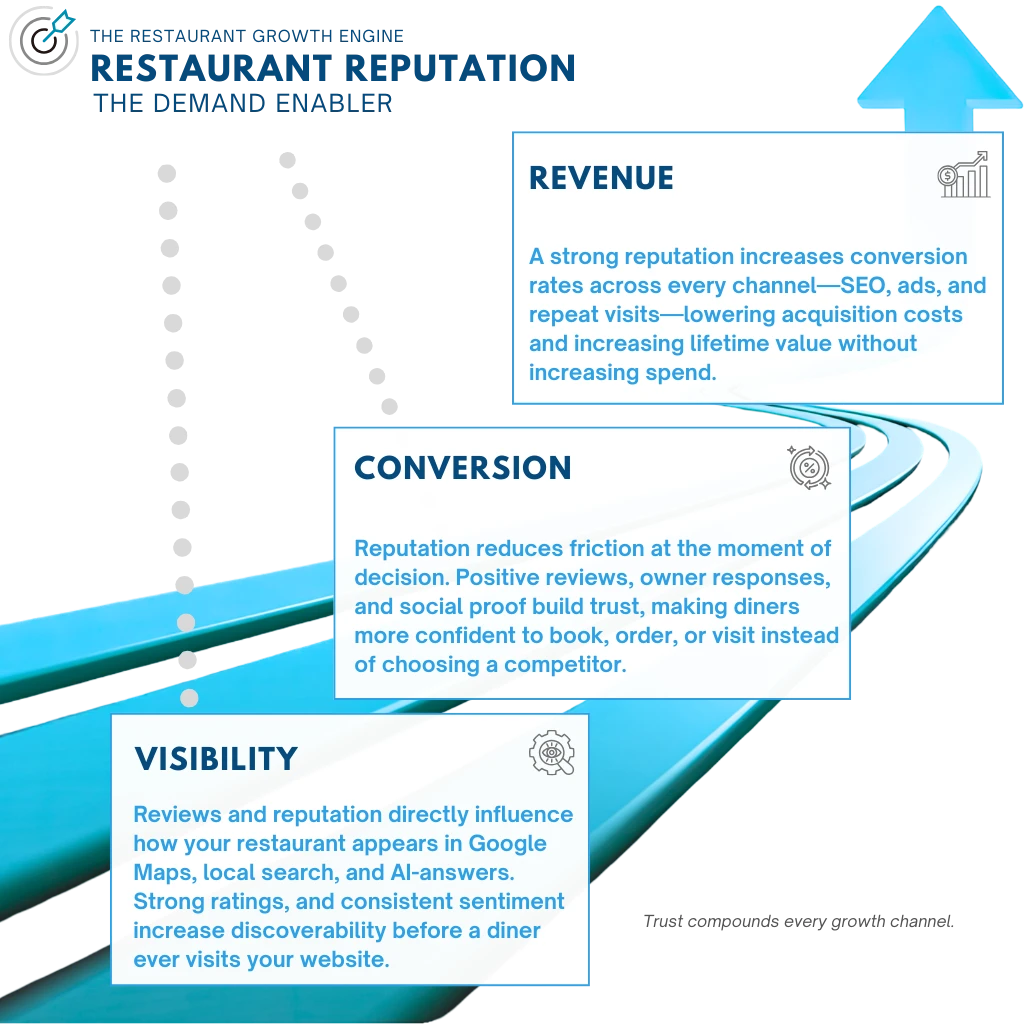
Reputation is no longer just a customer feedback issue. It is a search, trust, and revenue signal. Today, reviews influence:
Local rankings on Google Maps
Reviews and sentiment directly influence local rankings, map visibility, and how restaurants are summarized in AI-powered search – making restaurant SEO and AI search visibility inseparable from reputation management.
Click-through rates vs competitors
Guests consistently choose higher-trust options when comparing restaurants side by side – restaurants with ratings above 4.0 consistently see higher click-through rates in local search results.
AI-generated restaurant recommendations and summaries
AI platforms surface patterns and sentiment, not individual reviews.
Whether a guest orders direct – or chooses someone else
Reputation reduces hesitation and friction before a purchase decision is made.
AI search doesn’t read individual reviews. It summarizes patterns – that means recurring complaints, tone, and sentiment matter more than isolated stars.
If reputation isn’t connected to visibility and conversion, it doesn’t move the business.
For multi-location restaurant groups, reputation management requires centralized oversight with location-level execution.
What “Restaurant Reputation Management” Actually Means
- Alignment with Local SEO and AI search visibility
- Continuous monitoring across Google, Yelp, and key platforms
- Sentiment analysis by theme (food, service, speed, staff, value)
- Rating velocity and trend analysis
- Brand-safe response strategy (not templates)
- Issue escalation workflows between operations and marketing
Reputation becomes a demand enabler only when it’s connected to the full restaurant growth marketing system.
What Is Restaurant Reputation Management?
Restaurant reputation management is the structured process of improving, monitoring, and leveraging online reviews and customer sentiment to increase visibility, trust, and revenue across platforms like Google and Yelp.
Restaurant reputation management is part of a broader strategy known as online reputation management for restaurants, which focuses on monitoring reviews, improving ratings, and protecting visibility in search results.
Yelp, Paid Platforms & Reputation in the Age of AI Search
How AI Interprets Restaurant Reputation
AI-powered search experiences already summarize:
- “What people like”
- “Common complaints”
- “How this compares to similar restaurants”
Even with a decent star rating, negative themes resurface:
- Slow service
- Inconsistent food quality
- Poor value perception
That summary becomes your brand description—whether you wrote it or not.
Reputation now influences how your restaurant is described, not just whether it’s shown.

Use Cases by Restaurant Type
Single-Location Restaurants
- Stabilize ratings
- Remove conversion blockers
- Recover from negative review cycles
Competitive Urban Markets
- Protect map visibility
- Improve click-through vs competitors
- Reduce friction before ordering
Multi-Location Brands
- Brand governance at scale
- Location accountability
- Executive-level sentiment reporting
Yelp, Paid Platforms & the Hard Truth
We’ll be direct:
- Paying for ads does not fix reputation problems
- Visibility amplifies sentiment—good or bad
- AI summaries surface patterns, not sponsorships
- A weak rating profile erodes trust faster in competitive markets
Paid platforms don’t override guest experience. They simply make the outcome more visible.
How Modern Reputation Intelligence Works
We manage reputation using sentiment intelligence, not just monitoring:
- Centralized review intelligence (no silos)
- Pattern recognition across locations
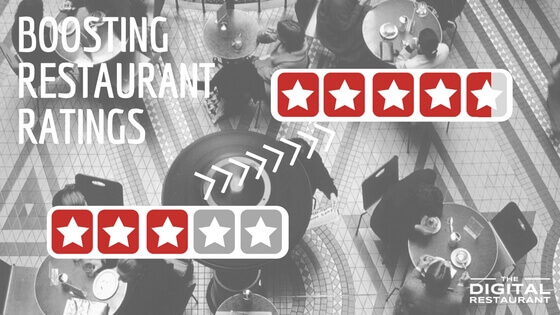
- Early-warning signals for rating drops
- Location vs brand-level accountability
- Insight that feeds SEO, CRO, and paid strategy
This is how reputation becomes a growth input, not noise.

How Reputation Fits Into the Growth Marketing System
1. Diagnose
Reputation risk and sentiment patterns are identified during assessment
2. Build
Website, local SEO, and trust signals are aligned
3. Grow
Ongoing reputation intelligence feeds visibility and conversion strategy
Reputation is not a deliverable – it’s a growth signal.
A strong reputation also increases conversion once diners land on your website. Restaurants with higher ratings see significantly better engagement and orders when paired with a well-designed restaurant website built for growth.
Take Control of Your Restaurant’s Online Reputation
Reputation problems are symptoms. We start by identifying what’s driving them—and how they affect growth.
We evaluate rating trends, sentiment risk, and visibility impact before recommending next steps.
Restaurant reputation management works best when integrated with a complete restaurant marketing agency approach – combining visibility, conversion, and performance across all channels.
Real results from restaurant reputation marketing:
“The Digital Restaurant delivers impactful digital marketing services that consistently yield impressive results, fostering ongoing collaboration. Their team brings industry expertise and provides regular monthly SEO reports for transparency. They actively seek feedback to continually enhance their performance.”

Mike Vitullo
Nabby’s Restaurant & Catering, Partner
What Our Restaurant Reputation Management Includes
- Review monitoring
- Review response frameworks
- Review acquisition system design
- Google Business Profile optimization
- AI search visibility alignment
- Multi-location reputation governance
FAQs
What is online reputation management and why is it important for my restaurant?
Online reputation management (ORM) is the practice of monitoring, influencing, and improving how your restaurant is perceived online. This involves tracking and responding to customer reviews, managing your social media presence, and ensuring accurate information across various online platforms. ORM is crucial for restaurants because 94% of diners choose where to eat based on online reviews, and a one-star increase on Yelp can lead to a 5-9% increase in revenue. Negative reviews can deter potential customers and damage your brand, while a positive online reputation attracts new customers and retains existing ones. Additionally, effective ORM provides valuable feedback for improving your services and menu. In today’s digital-first world, ORM can significantly impact your restaurant’s success.
How does restaurant reputation affect AI search results?
AI search platforms summarize overall sentiment, recurring themes, and ratings patterns from reviews. They don’t show individual reviews—they describe your restaurant based on aggregated perception, which directly impacts recommendations and trust.
What’s the difference between review management and reputation management?
Review management focuses on replies to customer reviews. Reputation management analyzes patterns, sentiment, and trends—and connects them to visibility, conversion, and growth outcomes.
How does reputation management impact my restaurant’s revenue?
Effective reputation management can significantly influence your restaurant’s revenue in several ways. Firstly, 90% of consumers read online reviews before visiting a business, and restaurants with higher ratings tend to attract more customers, leading to increased foot traffic. Additionally, customers are willing to spend 31% more on businesses with excellent reviews, which can boost your average spend per customer. Improved customer retention is another benefit, as responding to reviews can increase retention rates by up to 20%. Furthermore, a strong online reputation enhances your online visibility, improving search engine rankings and making your restaurant more discoverable to potential diners. Trust and credibility are also vital; 92% of consumers are more likely to trust recommendations from other people over branded content. Reviews provide insights into customer preferences, allowing you to refine your offerings and improve overall satisfaction. By actively managing your online reputation, you not only protect your brand but also drive revenue growth and build a sustainable, successful restaurant business.
How can I encourage more customers to leave positive reviews for my restaurant?
Encouraging customers to leave positive reviews is an essential aspect of building a strong online reputation. One effective strategy is to provide exceptional service and a memorable dining experience, as satisfied customers are more likely to share their positive experiences. You can also actively ask for reviews by including a friendly reminder on receipts, in follow-up emails, or through social media. Offering incentives, such as discounts on future visits or entry into a prize draw, can motivate customers to leave feedback. Additionally, make it easy for customers to leave reviews by providing direct links to your review profiles on platforms like Google and Yelp. Lastly, consider implementing a review generation tool that prompts customers for feedback shortly after their visit, ensuring that their experience is fresh in their minds. By creating a culture of feedback and making the process simple, you can significantly increase the number of positive reviews for your restaurant.
How does reputation impact online ordering and conversions?
Negative sentiment increases hesitation and drop-off before ordering. Strong reputation reduces friction and improves conversion rates across search, maps, and ordering flows.
How do multi-location restaurants manage reputation at scale?
By monitoring sentiment at both the brand and location level, identifying recurring issues, and holding locations accountable to consistent standards.
What’s the first step to improving restaurant reputation?
Start with a diagnostic assessment to identify sentiment risks, rating trends, and visibility impact before implementing changes.